
Import Shape Files
 English version
The Upload Shape tool allows you to import geographic data in Shapefile format and automatically create new objects within an object class in the project.
During the import, the geometries in the shapefile are converted into objects of the selected object class and the attributes are filled in using the values present in the file.
Preparing the Shapefile
The file must be uploaded in ZIP format and must contain the main shapefile components:
.shp.dbf.shx.prj
All files must have the same name.
The maximum ZIP file size is 10 MB.
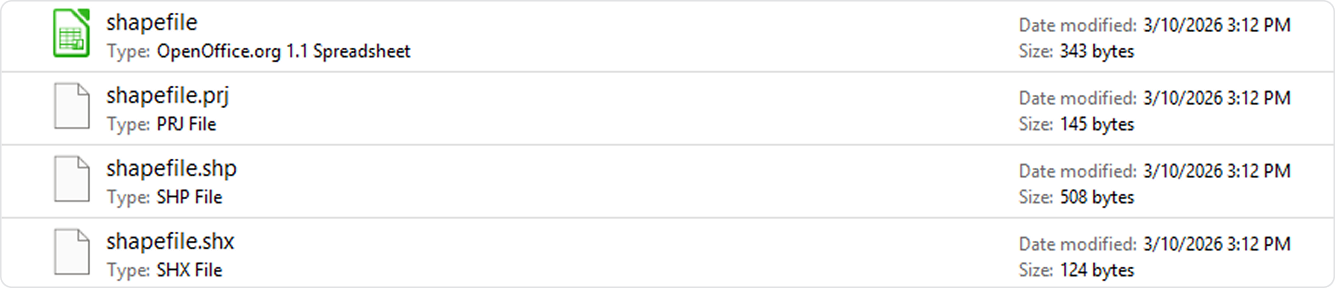
Only one Shape file can be uploaded at a time.
Each upload allows you to create objects for one object class only.
Importing a Shapefile
To import a shapefile:
1) Open the Tools section of the project.
2) Click the Upload Shape button.
3) Select the ZIP file containing the shapefile.
4) Select the object class to import the data into and click the Validate button to verify that the uploaded file meets the necessary requirements.
During this phase the system automatically performs some checks.
In particular it verifies that:
- the geometry type of the shapefile is compatible with the selected object class
- the shapefile contains sufficient attributes to fill in the mandatory ones of the object class
If the checks are passed, you can proceed with the import configuration.
Coordinate systems
The platform is compatible with the following coordinate systems:
| EPSG code | Name | Type |
| EPSG:4326 | WGS 84 | Geographic |
| EPSG:3857 | Web Mercator | Projected |
| EPSG:3003 | Monte Mario / Italy zone 1 (Gauss-Boaga Ovest) | Projected |
| EPSG:3004 | Monte Mario / Italy zone 2 (Gauss-Boaga Est) | Projected |
| EPSG:6707 | RDN2008 / Italy zone (E-N) — TM32 | Projected |
| EPSG:6708 | RDN2008 / Italy zone (E-N) — TM33 | Projected |
| EPSG:25832 | ETRS89 / UTM zone 32N | Projected |
| EPSG:25833 | ETRS89 / UTM zone 33N | Projected |
| EPSG:32632 | WGS 84 / UTM zone 32N | Projected |
| EPSG:32633 | WGS 84 / UTM zone 33N | Projected |
| EPSG:23032 | ED50 / UTM zone 32N | Projected |
| EPSG:23033 | ED50 / UTM zone 33N | Projected |
| EPSG:28992 | Amersfoort / RD New (Netherlands) | Projected |
| EPSG:27700 | OSGB36 / British National Grid | Projected |
| EPSG:2154 | RGF93 / Lambert-93 | Projected |
| EPSG:4258 | ETRS89 (geographic) | Geographic |
| EPSG:4269 | NAD83 (geographic) | Geographic |
| EPSG:4267 | NAD27 (geographic) | Geographic |
| EPSG:4230 | ED50 (geographic) | Geographic |
Mapping shapefile attributes
After the file has been validated, a screen is displayed that allows you to manually configure the attribute mappings. The system automatically suggests an initial match between the attributes in the shapefile and those of the object class.
The screen is organised in two columns:
- left: attributes present in the shapefile
- right: attributes of the object class
For each attribute of the object class you can select which shapefile attribute to use.
During configuration, some visual indicators are shown to help complete the mapping correctly.
In particular:
- Mandatory attributes of the selected object class that have not yet been filled in are highlighted in red.
- Shapefile attributes that have already been used are shown as linked and highlighted in green.
- A counter shows how many shapefile attributes have not yet been mapped.
Only attributes of the same type can be mapped together.
If a shapefile attribute is reused, the previous mapping is automatically removed.
The Import button becomes available only when all mandatory attributes have been mapped.
Starting the import
When you confirm the import by clicking Import, the system starts the upload process.
During this phase:
- The object class instances are created automatically
- Geometries are imported from the shapefile
- Attribute values are filled in according to the configured mappings
Leaving the project or refreshing the browser page will interrupt all ongoing uploads.
Monitoring the import status
In the page header, the Upload menu is available, which allows you to monitor the status, the import progress of shapefiles and the outcome of the last completed operation.
Information about the last upload remains visible for 4 hours from the start of the import.
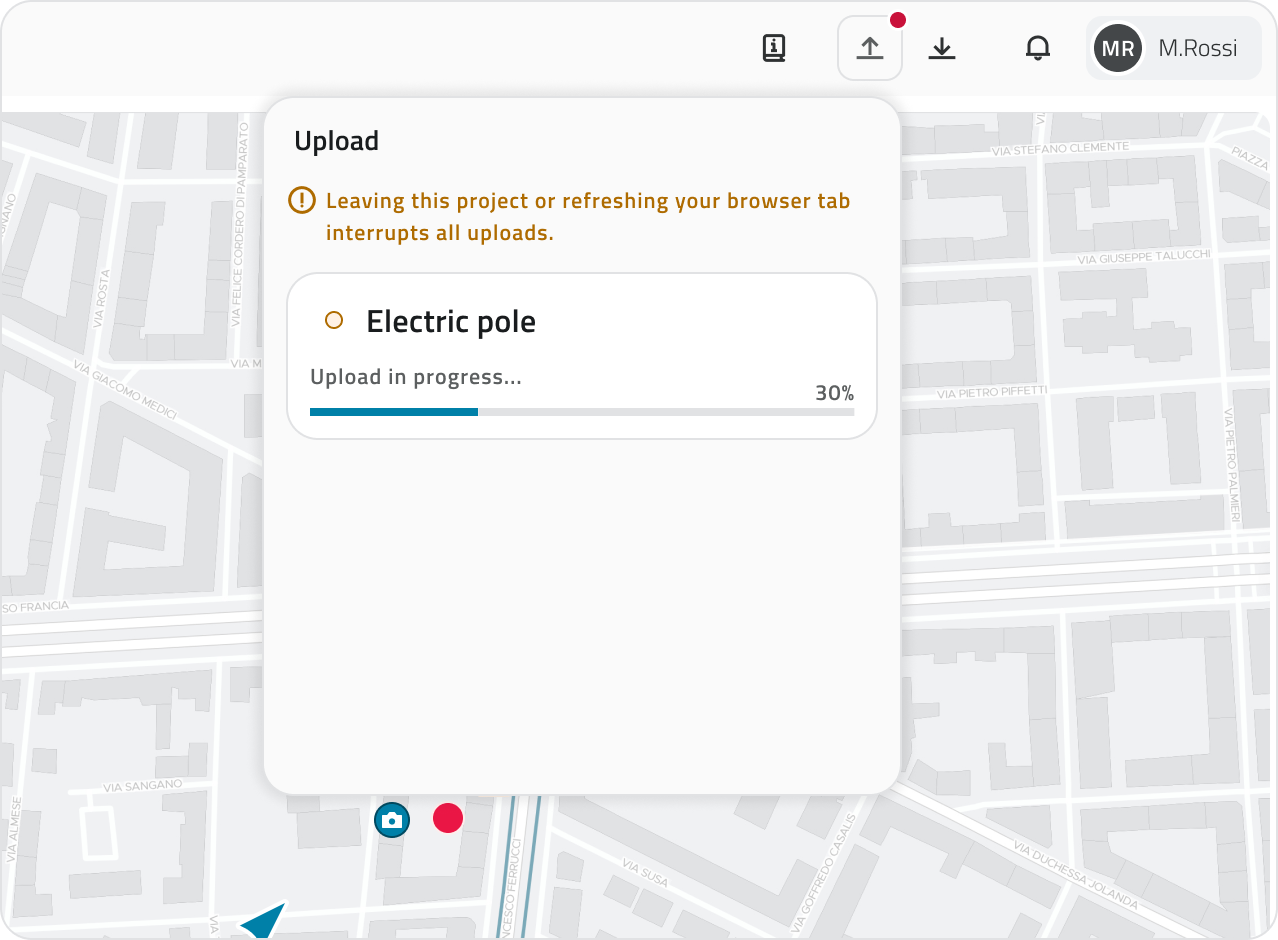
Only one Shape file can be uploaded at a time.
If necessary, the ongoing upload can be cancelled using the Cancel button.
Import completed
At the end of the import, the shapefile geometries are created in the selected object class. If some geometries are invalid or incomplete, they may not be imported.
The upload card shows the number of geometries created relative to the total present in the file.
Once the operation is complete, you can always download the import report, which contains a summary of the processed elements and any issues encountered.
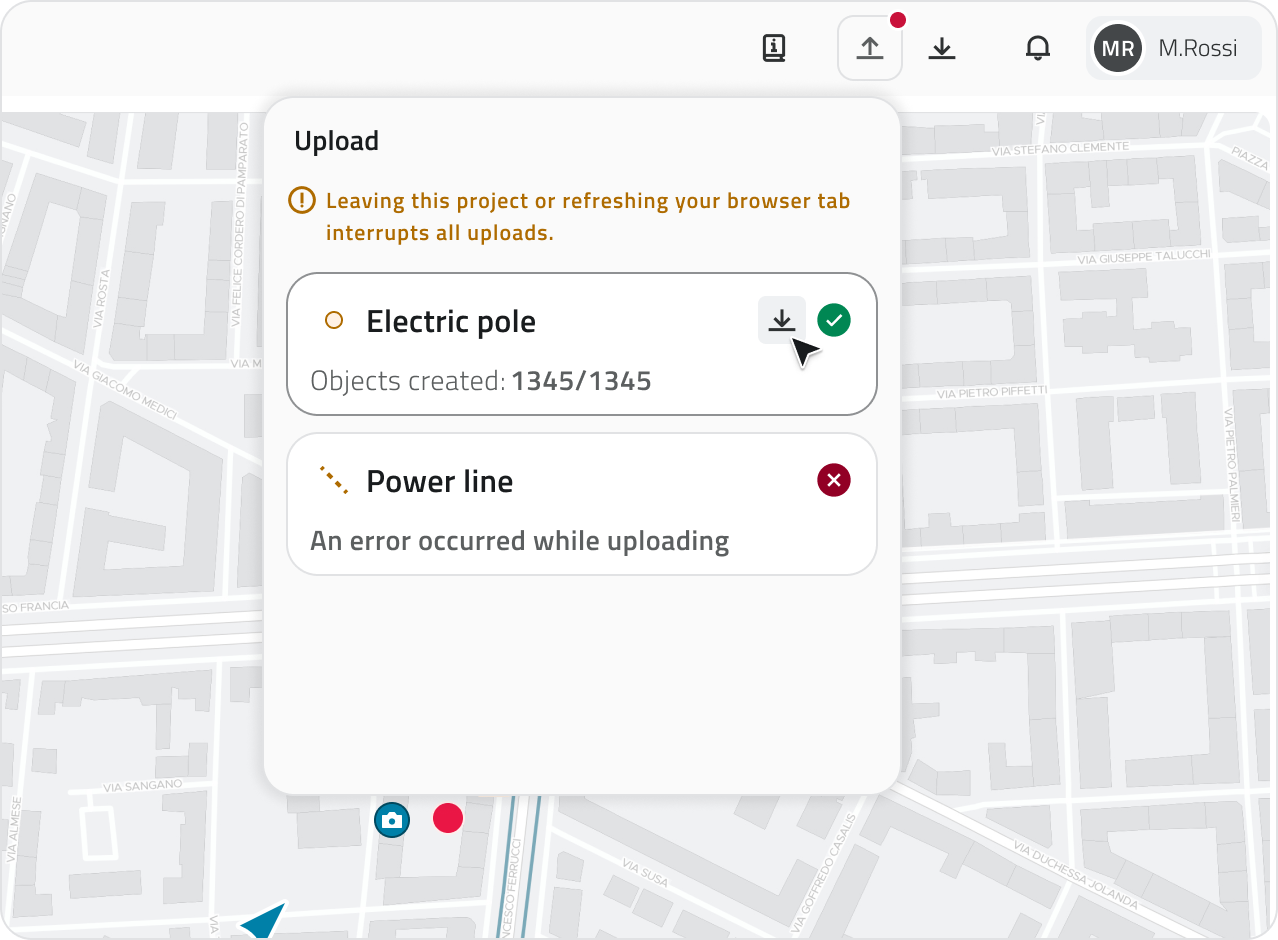
💡 Tip: Use the report to check for any issues: if the import is partial, the report allows you to identify the geometries that were not imported.
Links
 Italian version
Lo strumento Upload Shape permette di importare dati geografici in formato Shapefile e creare automaticamente nuovi oggetti all’interno di una classe oggetto del progetto.
Durante l’importazione, le geometrie presenti nello shapefile vengono convertite in oggetti della classe oggetto selezionata e gli attributi vengono compilati utilizzando i valori presenti nel file.
Preparare il file Shapefile
Il file deve essere caricato in formato ZIP e deve contenere i principali componenti dello shapefile:
.shp.dbf.shx.prj
Tutti i file devono avere lo stesso nome.
La dimensione massima del file ZIP è 10 MB.
È possibile caricare un solo file Shape alla volta.
Ogni caricamento permette di creare oggetti per una sola classe oggetto.
Importare uno Shapefile
Per importare uno shapefile:
1) Apri la sezione Tools del progetto.

2) Clicca sul bottone Carica Shape.
3) Seleziona il file ZIP contenente lo shapefile.
4) Seleziona la classe oggetto in cui importare i dati e clicca sul bottone Valida per verificare che il file caricato rispetti i requisiti necessari.
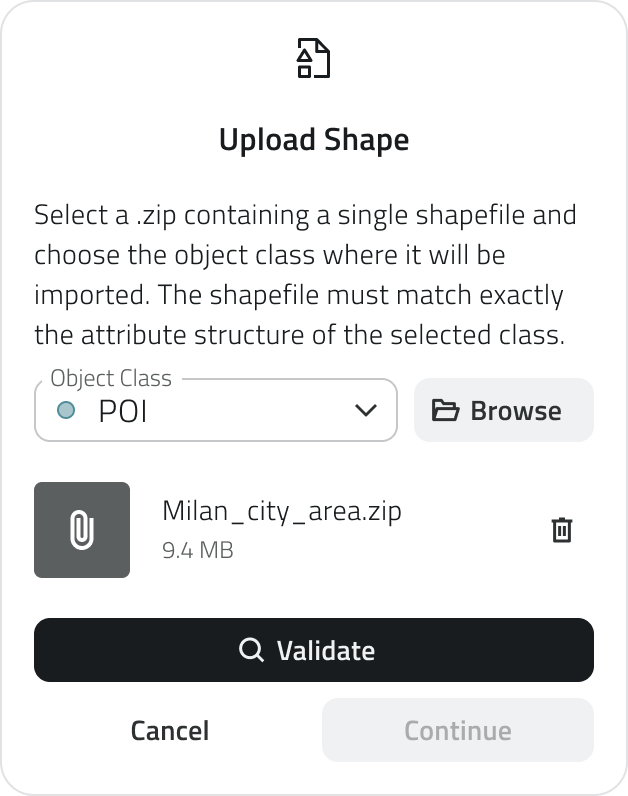
Durante questa fase il sistema esegue automaticamente alcune verifiche.
In particolare controlla che:
- il tipo di geometria dello shapefile sia compatibile con la classe oggetto selezionata
- lo shapefile contenga attributi sufficienti per compilare quelli obbligatori della classe oggetto
Se i controlli sono superati è possibile continuare con la configurazione dell’importazione.
Sistemi di coordinate
La piattaforma è compatibile con i seguenti sistemi di coordinate:
|
Codice EPSG |
Nome |
Tipo |
|
EPSG:4326 |
WGS 84 |
Geografico |
|
EPSG:3857 |
Web Mercator |
Proiettato |
|
EPSG:3003 |
Monte Mario / Italy zone 1 (Gauss-Boaga Ovest) |
Proiettato |
|
EPSG:3004 |
Monte Mario / Italy zone 2 (Gauss-Boaga Est) |
Proiettato |
|
EPSG:6707 |
RDN2008 / Italy zone (E-N) — TM32 |
Proiettato |
|
EPSG:6708 |
RDN2008 / Italy zone (E-N) — TM33 |
Proiettato |
|
EPSG:25832 |
ETRS89 / UTM zone 32N |
Proiettato |
|
EPSG:25833 |
ETRS89 / UTM zone 33N |
Proiettato |
|
EPSG:32632 |
WGS 84 / UTM zone 32N |
Proiettato |
|
EPSG:32633 |
WGS 84 / UTM zone 33N |
Proiettato |
|
EPSG:23032 |
ED50 / UTM zone 32N |
Proiettato |
|
EPSG:23033 |
ED50 / UTM zone 33N |
Proiettato |
|
EPSG:28992 |
Amersfoort / RD New (Netherlands) |
Proiettato |
|
EPSG:27700 |
OSGB36 / British National Grid |
Proiettato |
|
EPSG:2154 |
RGF93 / Lambert-93 |
Proiettato |
|
EPSG:4258 |
ETRS89 (geographic) |
Geografico |
|
EPSG:4269 |
NAD83 (geographic) |
Geografico |
|
EPSG:4267 |
NAD27 (geographic) |
Geografico |
|
EPSG:4230 |
ED50 (geographic) |
Geografico |
Associare gli attributi dello shapefile
Dopo la verifica del file, viene visualizzata una schermata che consente di configurare manualmente le associazioni tra gli attributi. Il sistema propone automaticamente una prima corrispondenza tra gli attributi presenti nello shapefile e quelli della classe oggetto.
La schermata è organizzata in due colonne:
- sinistra: attributi presenti nello shapefile
- destra: attributi della classe oggetto
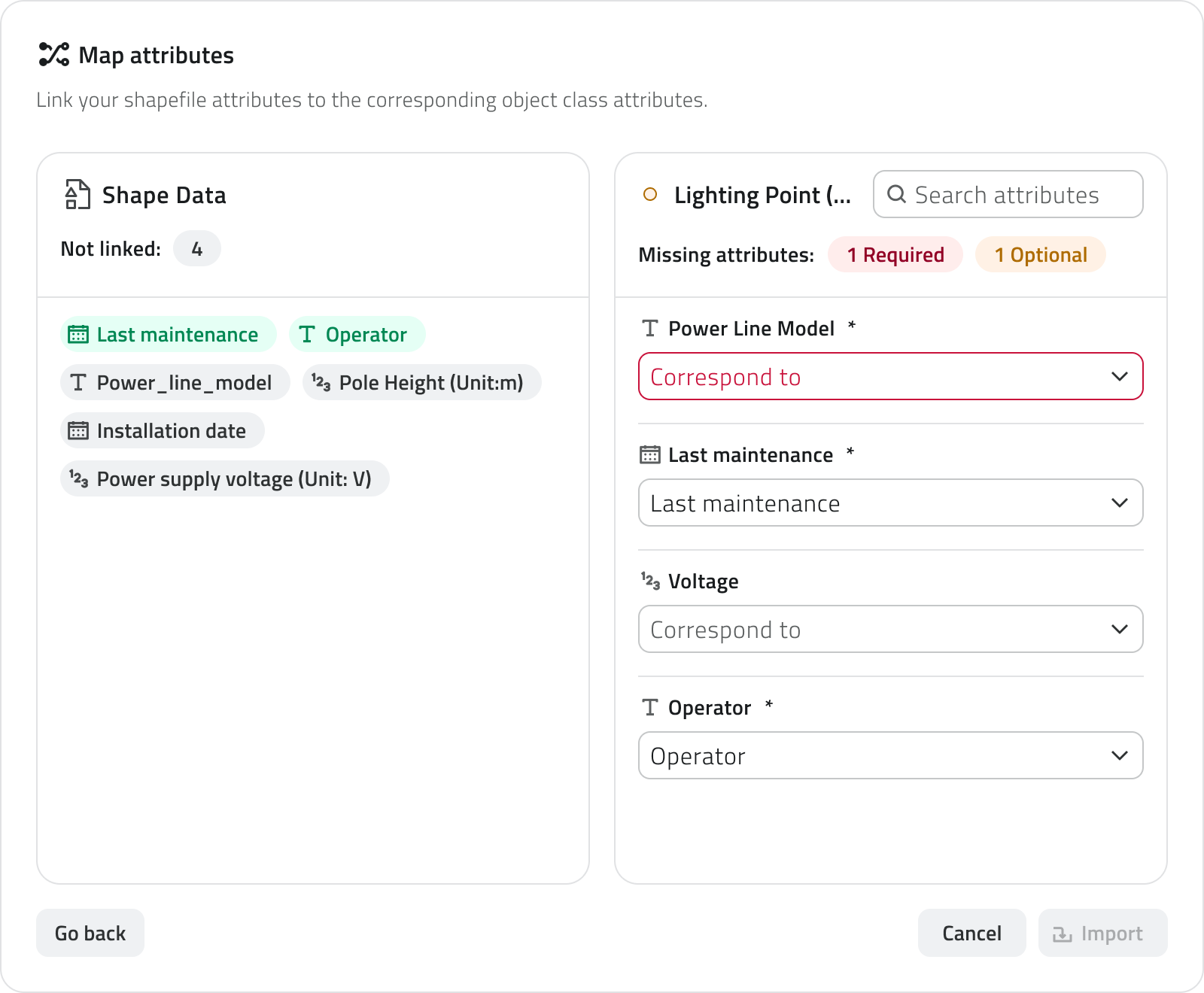
Per ogni attributo della classe oggetto puoi selezionare quale attributo dello shapefile utilizzare.
Durante la configurazione vengono mostrati alcuni indicatori visivi che aiutano a completare correttamente l’associazione.
In particolare:
- Gli attributi obbligatori della classe oggetto selezionata che non sono ancora compilati vengono evidenziati in rosso.
- Gli attributi dello shapefile già utilizzati risultano collegati e vengono evidenziati in verde.
- Un contatore indica quanti attributi dello shapefile non sono ancora associati.
È possibile associare solo attributi dello stesso tipo.
Se un attributo dello shapefile viene riutilizzato, l’associazione precedente viene automaticamente rimossa.
Il bottone Importa diventa disponibile solo quando tutti gli attributi obbligatori sono stati associati.
Avviare l’importazione
Quando confermi l’importazione cliccando su Importa, il sistema avvia il processo di caricamento.
Durante questa fase:
- Vengono create automaticamente le istanze della classe oggetto
- Le geometrie vengono importate dallo shapefile
- I valori degli attributi vengono compilati secondo le associazioni configurate
Lasciare il progetto o aggiornare la pagina del browser, comporta l'interruzione di tutti i caricamenti.
Monitorare lo stato dell’importazione
Nell'intestazione della pagina è disponibile il menu dell' Upload, che consente di monitorare lo stato, il progresso di importazione degli shapefile e l’esito dell’ultima operazione completata.
Le informazioni relative all’ultimo upload restano visibili per 4 ore dall'avvio dell'importazione.
È possibile caricare un solo file Shape alla volta.
Se necessario, il caricamento in corso può essere annullato tramite il pulsantebottone Cancella.
Importazione completata
Al termine dell’importazione le geometrie dello shapefile vengono create nella classe oggetto selezionata. Se alcune geometrie risultano non valide o incomplete, potrebbero non essere importate.
La card dell’upload mostra il numero di geometrie create rispetto al totale presente nel file.
Al termine dell’operazione è sempre possibile scaricare il report dell’importazione, che contiene il riepilogo degli elementi elaborati e di eventuali problemi riscontrati.
💡Suggerimento: Usa il report per verificare eventuali problemi: se l'importazione è parziale, ti permette di identificare le geometrie che non sono state importate.
Collegamenti
Last update: 22 May 2026