
Satellite Humidity & Irrigation Service
Click here to donwloaddownload the PDF
Satellite UrbanizationHumidity & Irrigation Service
Welcome. In this video, we explore aone of the most practical exampleexamples of how satellite-derived analytics and geospatial intelligence can be transformed into a concrete decision-support tool for urban planning and territorial resilience. The objective is to understand how Earth observation technologies can movesupport beyondprecision simpleagriculture. visualizationWhile many satellite services focus on monitoring and becomeanalysis, the humidity and irrigation service integrated into EagleArca takes a multidimensional framework for understanding how a territory actually behaves. To do this, we will not treat the city as a static picture seen from above, but as a physical system that can be measured. A satellite image of a city may show buildings, roads and green spaces, but on its own it tells us little about how that environment is changing or where it is vulnerable. The Urbanization service is designed to go muchstep further.
WeIts will follow a comprehensive urban risk and resilience analysis generated over a complete Area of Interest, often abbreviated as AOI. Within this area, thousands of individual spatial cells are processed, each one carrying environmental, urban, climatic and geotechnical information. The resultobjective is not asimply singleto map,describe the current condition of agricultural land, but to support daily operational decisions, answering one very practical question: where, when, and how much should we irrigate. This shift, from describing a layeredfield portraitto ofactively advising on it, is what makes the cityservice asdistinctive. aThroughout livingthis system. In the following sections,video, we will look at whatwhy thissuch a service examines,is whichneeded, satellitethe dataphilosophy behind it, the information it reliesdraws on,upon, what kind of resultshow it produces,reaches a decision, and finally how all of this information is visualizeddelivered and exploredvisualized within the EagleArca platform. And throughout, one idea will return constantly: none of these indicators stands alone. Their real value emerges only when they are read together.
WhatWhy This Service Exists
Agriculture has always depended on water availability. Traditionally, irrigation decisions have been based on experience, field observations and fixed schedules. However, modern environmental conditions are becoming increasingly complex. Water resources are limited, climatic conditions are more variable, and sustainable farming requires optimizing every available resource. For these reasons, the ServiceEagleArca Examineshumidity service was designed to transform heterogeneous environmental observations into daily irrigation recommendations. The goal is to replace rigid, generic schedules with guidance that adapts continuously to the real conditions of the land.
The Underlying Philosophy
The Urbanizationphilosophy behind this service isrests builton aroundan important principle: satellite images should not be interpreted as real-time snapshots of the field. Instead, they are treated as observations acquired at a simplecertain butpoint powerfulin idea:time, awhich cityare then combined with continuously updated meteorological information, irrigation records and short-term weather forecasts. This is awhat physicalallows system,the andsystem liketo anyproduce physicaloperational system,recommendations itevery canday, beeven describedwhen throughnew measurablesatellite variables.imagery is temporarily unavailable. Rather than focusingdepending on the moment a satellite passes overhead, the service maintains a continuously evolving understanding of the field, updated daily from many sources.
The Three Questions
In practice, the service revolves around three fundamental questions. First, which portions of the cropland require irrigation today? Second, how much water is suggested? And third, can irrigation be postponed because rainfall is expected in the coming days? A key point is that the service does not generate a single aspect,recommendation for an entire field. Instead, it produces pixel-based decision maps, allowing different sections of the servicesame examinesfield theto urbanreceive environmentdifferent acrossrecommendations severalaccording complementaryto dimensions,their becauselocal urbanconditions. riskThis andspatial resilience never depend on one factor alone.
The first dimensiondetail is what physically exists inside the territory: how much of it is vegetation, soil, built environment or water. This is the necessary starting point, because urban risk is not interpreted in the same way inturns a forestedgeneral landscape,irrigation anstrategy agriculturalinto regionprecise, orsite-specific a dense city. The second dimension is the physical extent of the city and how it changes over time. Urban growth is not uniform. In some places development fills the gaps inside existing neighbourhoods; in others it expands along the edges of the city, or appears as scattered, isolated patches far from the existing urban fabric. Each of these patterns has very different consequences for infrastructure and for the surrounding landscape.guidance.
The third dimension concerns the surfaces of the city and their environmental behaviour. Artificial materials such as asphalt and concrete do not behave like soil or vegetation. They prevent water from infiltrating into the ground, they absorb and store heat, and they alter the local climate. The service therefore examines how sealed the urban surface is, how much green space remains, and how these factors influence both water management and thermal conditions. The fourth dimension is thermal behaviour: the tendency of cities to become warmer than the rural areas around them, with direct consequences for energy demand, public health and comfort.
The fifth dimension is environmental and atmospheric pressure: the quality of the air over the urban area, and the broader climatic stress to which the city is subjected, combining the effects of heat and precipitation. And the final dimension is the stability of the ground itself and the city's exposure to water-related risk: whether the terrain is slowly sinking or shifting beneath buildings and infrastructure, and where water is likely to accumulate during intense rainfall. Taken together, these dimensions describe not just where the city is, but how it lives and where it is fragile.
WhatThe Data the Service UsesSources
To examineanswer these many dimensions,questions, the Urbanization service does not rely on a single satellite. It integrates observationsmultiple from several missionssources of the European Union's Copernicus programme,information, each contributing a different piece of evidence. The first and complementarymost physicalimportant measurement. Thissource is fundamental,weather becauseinformation. noDaily singlemeteorological sensorproducts canprovide capturetemperature, precipitation, evapotranspiration, wind speed, humidity, runoff, cloud cover and estimates of soil water content. These variables represent the fullmain complexitydriver of ancrop urbanwater environment. Optical imagery, radar backscatter, thermal emissiondemand and atmosphericform chemistrythe all describe different physical aspectsbackbone of the samedecision-making territory, and the real power lies in fusing them into a single coherent picture. process.
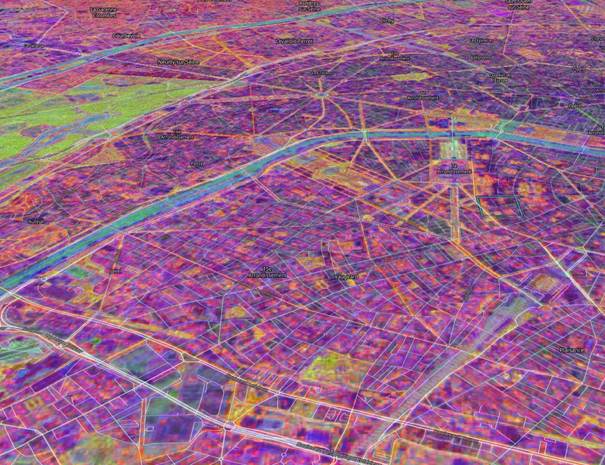
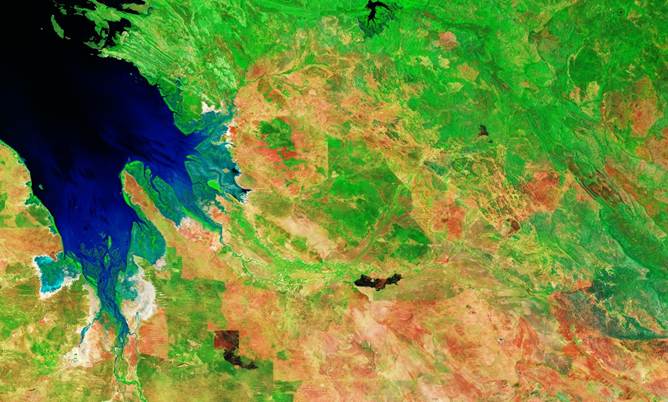
The first essential source is Sentinel-2, theprovides optical multispectralobservations mission.of Sentinel-2vegetation. doesThrough not simply produce images; it measures how the Earth's surface reflects solar radiation across thirteen spectral bands, from the visible to the short-wave infrared. Because different materials,indices such as vegetation,NDVI, soil,NDMI, NDRE, SAVI and other spectral indicators, the system evaluates crop vigour, moisture stress, vegetation activity and the presence of possible surface water. These indicators help identify where crops are healthy, where they are experiencing stress, and where excessive water andmay artificial surfaces, reflect radiation in characteristic ways, this multispectral information allows each part of the territory toalready be classified into land-cover categories. This classification is the foundation of the entire service: it is what allows us to distinguish buildings from vegetation, to measure how much of the area is artificial, and to track how that proportion changes over time. Sentinel-2 also provides the vegetation information used to assess urban green coverage, and its detailed spatial resolution makes it possible to follow urban patterns at the scale of individual neighbourhoods.
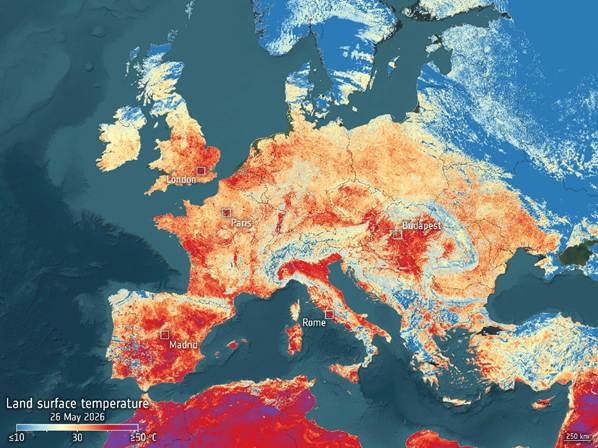
The second source is Sentinel-3, and in particular its thermal observation capability. Unlike optical sensors that measure reflected sunlight, Sentinel-3 measures the radiation that surfaces themselves emit, which makes it possible to estimate the physical temperature of the ground, known as Land Surface Temperature. This is exactly what is needed to study the urban heat island effect, mapping where heat accumulates and identifying the most thermally vulnerable zones.present.
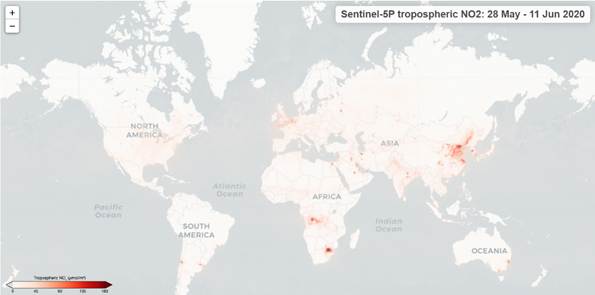
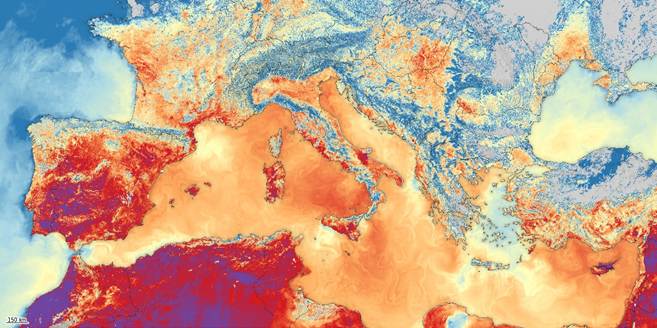
TheSentinel-3 thirdcontributes sourcethermal isand Sentinel-5P,atmospheric information. Parameters such as land surface temperature, vapour pressure deficit, dew point, soil wetness and cloud fraction provide additional evidence regarding atmospheric stress and field dryness. By combining optical and thermal observations, the atmosphericservice monitoringgains mission.a Itsmuch TROPOMImore instrument,complete the Tropospheric Monitoring Instrument, measures the concentrationunderstanding of pollutantscrop and other atmospheric components across the globe. In the urban context, this provides the basis for assessing air quality, since cities concentrate the traffic, industry and energy consumption that drive pollution.conditions.
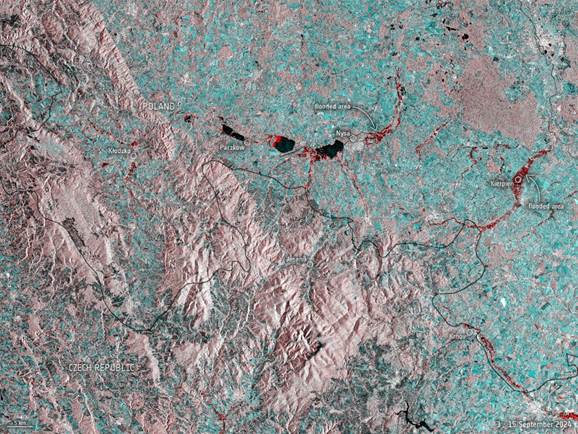
TheSentinel-1 fourthcan sourceoptionally provide background information on soil moisture through radar observations. Since radar penetrates clouds and operates independently of daylight, it adds valuable information regarding field conditions. Terrain information derived from digital elevation models can also be integrated to estimate slope and runoff effects, since steeper terrain tends to lose part of the rainfall through runoff, reducing the amount of water that effectively contributes to soil moisture.
Another important component is Sentinel-1,the irrigation log. The system records the radaramount mission.of Becausewater radaralready applied to the field and uses this information to continuously update the field water balance. In addition, the service maintains what can be thought of as a simplified virtual water reservoir for every agricultural pixel. This virtual reservoir represents the amount of useful water currently available to the crop. Every day, the reservoir is anupdated activeaccording sensorto thata emitssimple water balance equation: the previous water state, plus effective rainfall and irrigation, minus the estimated crop water demand. In this way, each pixel carries its own microwavecontinuously signal,updated Sentinel-1memory canof observehow much water the surfacecrop regardlessactually has at its disposal.
The Role of cloudForecasts
One of the ground,most oninteresting aspects of the ordersystem is its use of millimetres.weather Thisforecasts. Instead of considering only today's conditions, the service analyses expected precipitation and evapotranspiration over the next 24, 48 and 72 hours. If the forecast indicates that upcoming rainfall will provide sufficient water to satisfy crop demand, irrigation can be postponed. In this way, the service avoids unnecessary irrigation, reducing water consumption and increasing sustainability. Looking ahead, rather than only at the present, is what allows the servicesystem to measureprevent subsidence,waste thebefore slowit sinking or shifting of the ground, and to assess the stability of the terrain beneath buildings and infrastructure.happens.
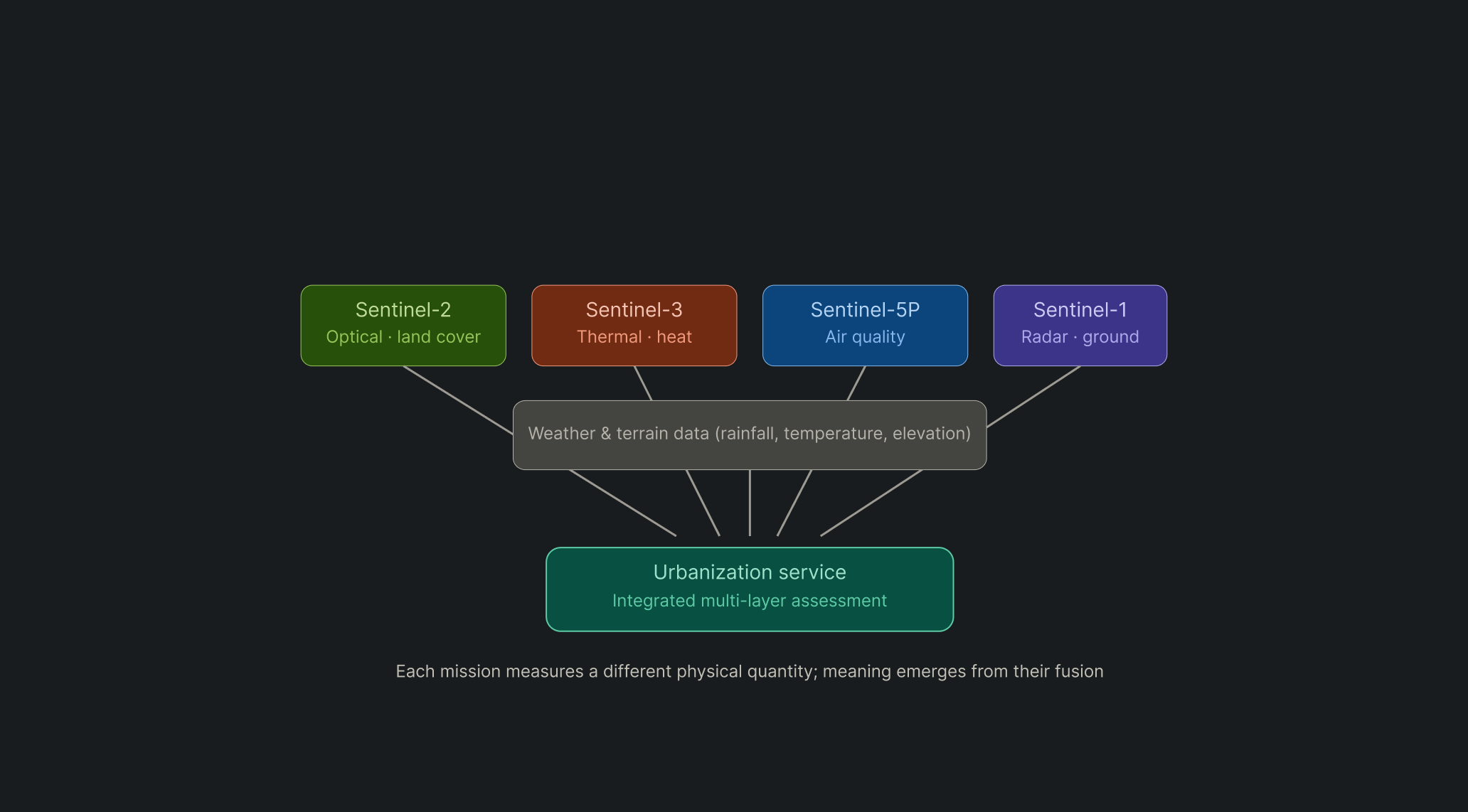
Finally, the service integrates meteorological and climatic information, such as rainfall and temperature, together with terrain data such as elevation models. This information is essential for the climate stress and flood-related components, where the shape of the land and the intensity of precipitation combine with the urban surface to determine risk. The strength of the service lies precisely in this integration. Each mission measures a different physical quantity, and only by combining them does a complete picture of the urban environment emerge.
AppliedThe Results
Once these data sources are combinedProcess and processed,Operational the service produces a structured set of indicators that describe the state of the urban environment and its exposure to risk. Let us walk through them in a logical order, and at each step look not only at what is measured, but at why it matters.
Land Classification
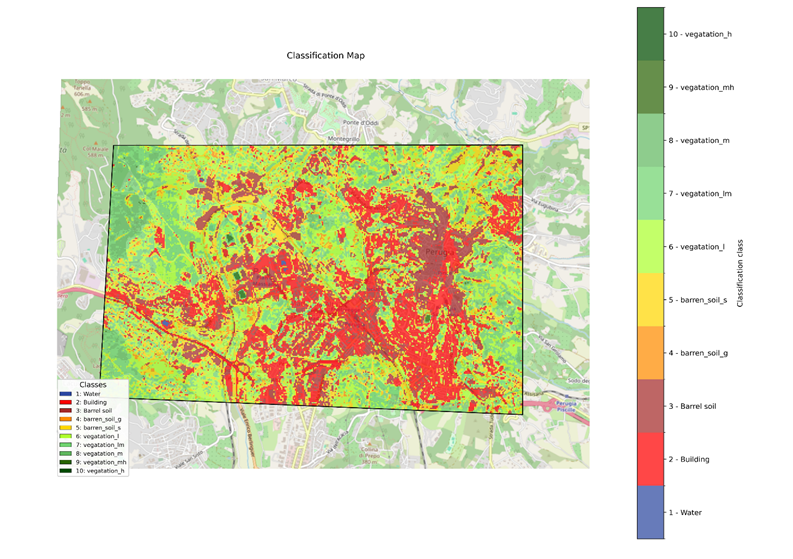
The analysis begins with a fundamental layer: land classification. Before evaluating risk or resilience, it is necessary to understand what physically exists inside the territory. Through satellite-based classification algorithms, every cell inside the area is assigned to a macro class such as vegetation, soil, building or water. In this specific analysis, vegetation represents the dominant component of the territory, followed by soil and then buildings, while water occupies only a minimal fraction of the area. This first classification may appear simple, but it establishes the context for every subsequent analysis. Land cover becomes the first explanatory variable for everything that follows: vegetation affects temperature regulation, infiltration capacity and ecological resilience, while built surfaces influence how runoff is generated and how heat accumulates.
Urban Footprint and Urban Growth
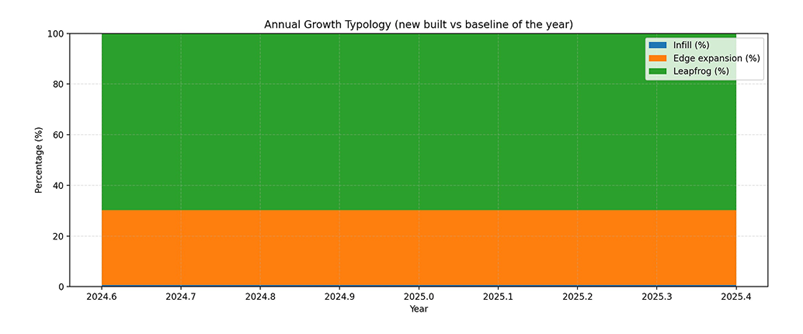
From this foundation, the analysis moves to the urban footprint. It estimates the amount of built-up area and artificial coverage inside the AOI. In this case, approximately 4.8 square kilometres are classified as built-up, with artificial surfaces covering around nineteen percent of the territory. But static urban extent alone does not tell the full story, because cities evolve dynamically. The analysis therefore investigates urban growth by comparing built-up patterns over time. Interestingly, in this area it identifies a negative urban expansion value. This does not necessarily mean the city is shrinking; it may indicate either a real contraction or differences in classification between the time intervals being compared. At the same time, hotspot detection identifies specific localized areas where a genuine change from non-built-up to built-up conditions has occurred.
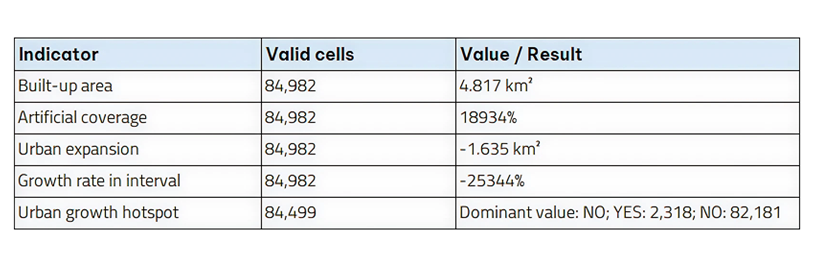
This introduces an important urban planning concept: growth typology. Not all urban growth occurs in the same way. The analysis distinguishes between infill development, which fills the gaps inside existing urban areas; edge expansion, which extends growth along existing boundaries; and leapfrog development, which appears as isolated patches disconnected from the existing urban fabric. In this area, leapfrog growth dominates. From an urban planning perspective, leapfrog growth is often considered problematic, because development in isolated patches frequently increases infrastructure costs, creates transportation inefficiencies and leads to environmental fragmentation. By contrast, compact growth and infill development are usually considered far more sustainable.
Impervious Surfaces and Green Coverage
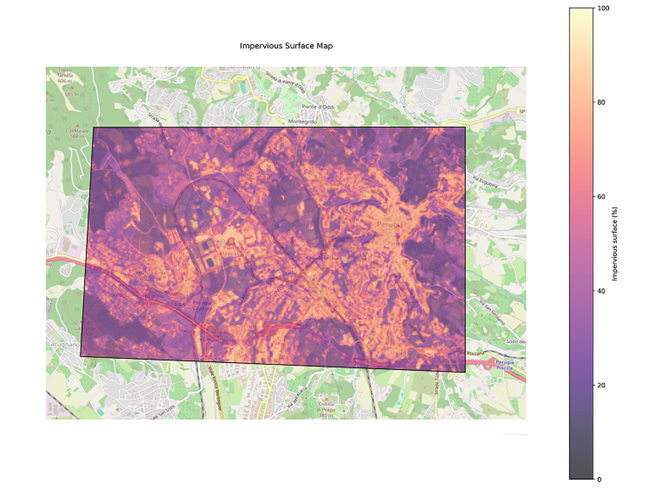
The nextfinal indicatordecision process combines all the available evidence: previous soil conditions, Sentinel-2 vegetation stress indicators, Sentinel-3 atmospheric information, optional Sentinel-1 soil moisture, forecast rainfall, evapotranspiration and terrain characteristics. An important feature of this design is oneits robustness. Even if some optional layers are missing, the system continues to operate, assigning a lower confidence score instead of the most operationally relevant: impervious surface estimation. In this analysis, approximately fifty percent ofinterrupting the territoryprocess. exhibitsThis design philosophy ensures that the characteristicsservice associatedremains withoperational pavedunder orreal-world low-infiltrationconditions, surfaces.where Imperviousdata surfacesis fundamentallynot alteralways the hydrological behaviour of the landscape: rainwater that would naturally infiltrate into the soil instead becomes surface runoff, increasing pressure on drainage systems and elevating flood susceptibility. Consistently with this, the analysis identifies thousands of cells associated with runoff risk.complete.
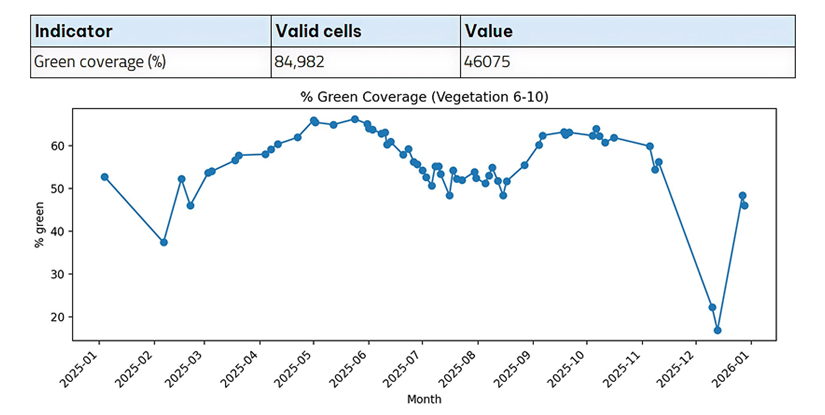
The analysis then evaluates ecological resilience through green coverage. Vegetation occupies approximately forty-six percent of the area. But urban vegetation is much more than aesthetics. Green areas regulate temperature through evapotranspiration, improve air quality, reduce runoff, support biodiversity and enhance human well-being. In resilient city design, vegetation functions as genuine environmental infrastructure.
UrbanThe Heat Island
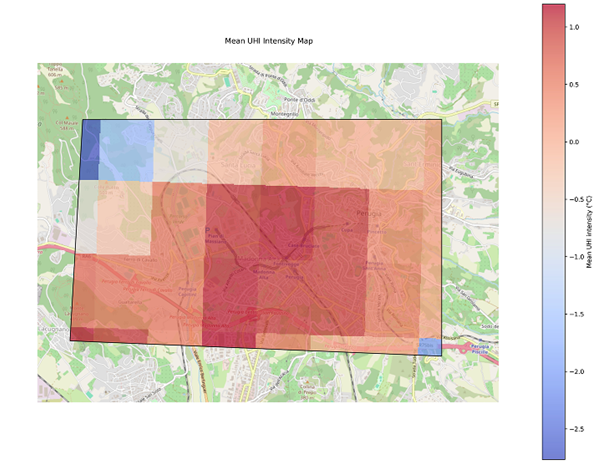
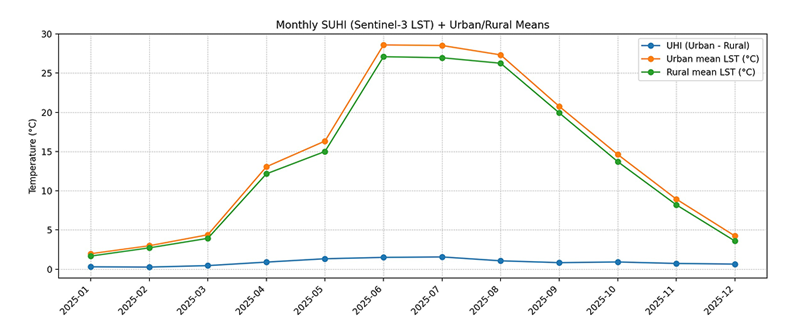
This relationship becomes particularly evident with the Urban Heat Island. Heat islands are areas where urbanized surfaces become thermally warmer than the surrounding environment. Here the mean urban heat island intensity is relatively moderate, although the vulnerability zones vary substantially across the area. Heat islands are one of the clearest examples of how urban morphology influences local climate: materials such as asphalt and concrete absorb solar radiation during the day and release it slowly at night, while reduced vegetation and limited airflow amplify the phenomenon. Excessive urban heat affects energy demand, public health and environmental comfort, and it concentrates precisely where vegetation is scarce and impervious coverage is high.
Satellite-Based Air Quality
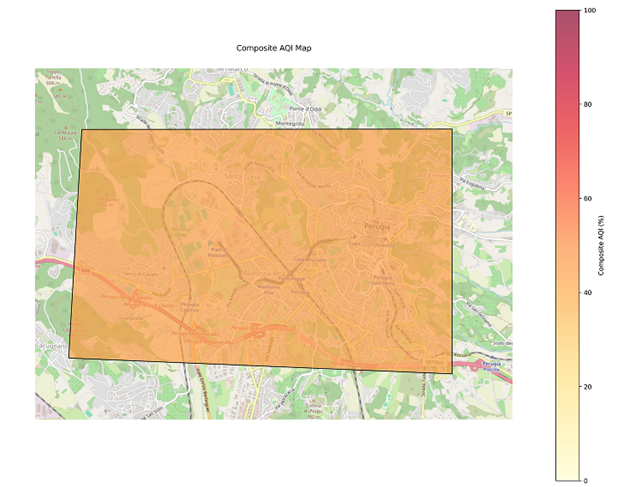
The analysisoutput thengenerated integratesby atmosphericthe observationsservice throughis far richer than a satellite-basedsimple airyes-or-no qualityirrigation index.recommendation. CompositeSeveral airGeoTIFF qualitylayers valuesare produced. These include estimated water demand, suggested irrigation amount in millimetres, maps indicating where irrigation can be postponed, confidence scores and pollutionfinal distributions are estimated spatially across the entire AOI. This introduces an important principle: urban environments should not be evaluated only through physical infrastructure. Environmental quality must also be considered, because air quality directly influences public health, urban attractiveness and long-term sustainability. Mapping pollution spatially, rather than relying on a single average, is what reveals local pressures where they actually occur.
Climate Stress

The next indicator moves towards climate adaptation through the Climate Stress Index. This metric combines deviations in heat and precipitation behaviour to identify stressful conditions relative to a baseline, and it also estimates the frequency of heatwave conditions. Climate stress indicators are increasingly important because urban systems are now exposed to growing climatic uncertainty, and infrastructure designed under historical climatic assumptions may not perform adequately under future conditions.
Subsidence and Ground Stability
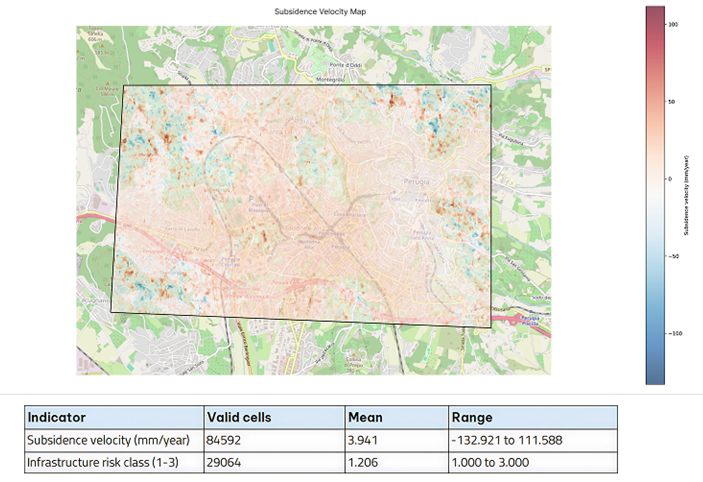
The analysis then enters the geotechnical domain through subsidence analysis. Ground movement, derived from satellite interferometric observations, reveals the vertical displacement behaviour of the terrain and the associated infrastructure riskdecision classes. SubsidenceThe isdecision map classifies every agricultural pixel into one of thefour mostcategories: powerfulno examplesdata, no irrigation required, postpone irrigation, or irrigation recommended. Additional evaluation layers provide a simplified interpretation of whatcrop satellitewater monitoringconditions canusing achieve:a deformationtraffic-light at the scale of millimetres can be observed consistently over very large territories. This is extremely valuable for transportation networks, historical city centres, pipelines and urban infrastructure management, where even slow ground movement can have serious consequences over time.approach.
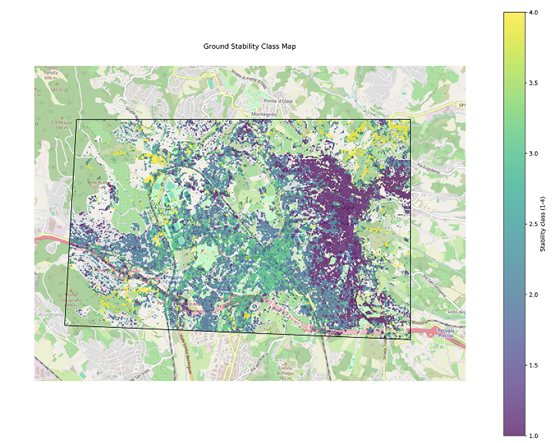
GroundThis stabilityallows analysisusers complementsto this by classifying stability conditions across the area and identifying alert zones, where deformation anomalies deserve additional investigation. In this analysis, thousands of alert cells are identified. Together, subsidence and ground stability describeunderstand not only the current situation, but also how water availability is expected to evolve over the coming days. The ratio between forecast rainfall and crop demand provides an estimate of how much the ground is moving, but where that movement could threaten the built environment.
Flood Susceptibility
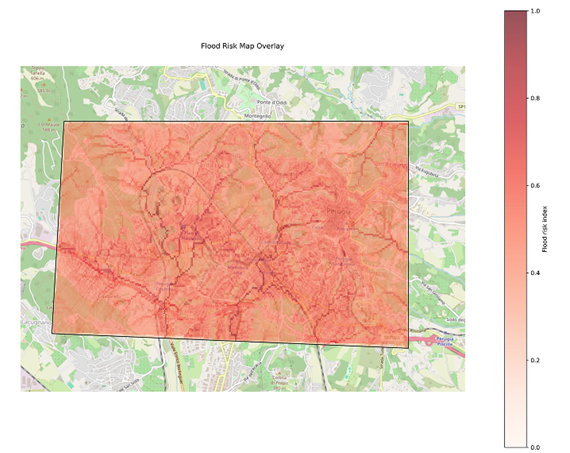
Finally, the analysis concludes with one of the mostcrop integratedwater assessmentsrequirement ofwill all:be floodnaturally susceptibility.satisfied Floodby riskprecipitation. isBesides notraster treatedproducts, asEagleArca generates human-readable summaries and smart alerts. These alerts transform complex geospatial statistics into operational messages. For example, the system may indicate that a singlelarge parameter, but as the result of multiple interacting variables, including terrain morphology, drainage behaviour, surface imperviousness and rainfall.
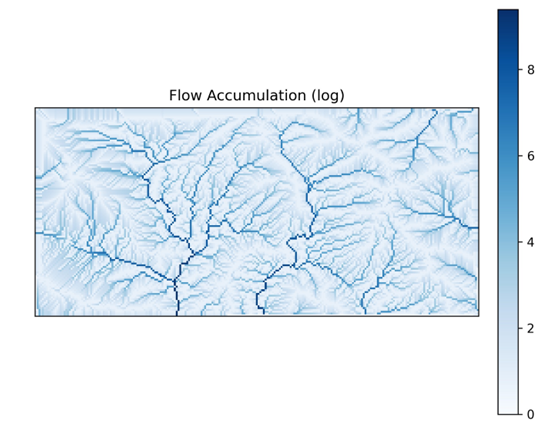
To support this, several classical hydrological descriptors are introduced. A Digital Elevation Model describes the shapeportion of the terrainfield andrequires controlsirrigation, that irrigation can safely be postponed because rainfall is expected, or that the directionconfidence inof whichthe surface water flows and where it accumulates. Flow accumulation maps represent how many upstream cells drain into each location, highlighting where runoff naturally converges. Slope calculations describe terrain steepness, since steeper slopes promote rapid drainage while flatter areas allow water to accumulate. The Topographic Wetness Index estimates where waterdecision is mostreduced likelybecause tosome remaininformation inlayers thewere landscape, typically in valley bottoms and poorly drained terrain. And the extracted drainage network approximates the natural channels through which runoff travels.unavailable.
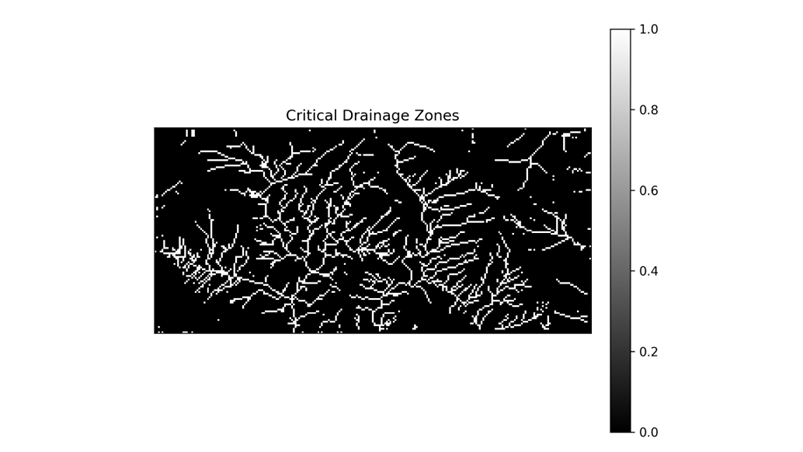
By combining these descriptors with imperviousness and rainfall, the analysis identifies critical drainage zones, where multiple risk conditions converge simultaneously. These become priority areas for monitoring and mitigation planning, because they are where urban drainage systems are most likely to come under stress during extreme rainfall events.
Visualization in EagleArca
WhatInside makes this kind of analysis particularly powerful is not any individual metric on its own. The true value emerges through the integration of heterogeneous geospatial information. Classification, urban growth, heat, air quality, climate stress, subsidence, terrain morphology and flood susceptibilityEagleArca, all contributethese to a single, multidimensional understanding of how the territory behaves. This reflects the evolution of modern Earth observation systems. Satellite platforms are no longer simply imaging systems. They haveproducts become analyticalgeoreferenced infrastructures,GIS capable of describing environmental, urban and climatic dynamics simultaneously. When these indicators are integrated inside a GIS-based platform such as EagleArca, they become operational tools rather than isolated results.
In EagleArca, each of the indicators we have discussed corresponds to a geospatial layerlayers that can be visualized onin theboth map. Because all layers share the same coordinate system2D and are3D georeferencedenvironments. within the same spatial framework, theyUsers can beinspect overlaidirrigation recommendations spatially, compare them with vegetation health, soil moisture, temperature and comparedweather directly.layers, Thisand isobserve whathow turnsconditions separateevolve measurementsthrough time. Instead of treating agriculture as a collection of isolated measurements, EagleArca transforms satellite observations, weather models, irrigation logs and forecasts into genuinea understanding.unified Adecision-support zone of elevated surface temperature can be examined alongside the classification layer to confirm that it corresponds to dense building with little vegetation. An area flagged for ground instability can be overlaid with the built-up footprint to identify which infrastructure is exposed. A critical drainage zone can be read together with the impervious surface layer and the terrain model to understand exactly why water concentrates there. In each case, the meaning comes from the relationship between layers.system.
From an operational perspective, this supports decision-making for urban planners, infrastructure managers, environmental agencies and resilience strategies. Users can activate and deactivate layers, focus on specific areas of interest, and explore how indicators evolve over time, distinguishing steady trends from sudden changes. Ultimately, this demonstrateshumidity and irrigation service represents an example of how satellite-derivedEarth intelligenceobservation technologies are evolving from passive monitoring systems into active decision-support infrastructures. By combining satellite imagery, weather forecasts, historical information and field management data, the system helps farmers optimize water use, improve crop resilience and support sustainable agricultural practices. Rather than simply observing the field, the service continuously interprets its behaviour, predicts its future needs, and provides operational recommendations that can transformcontribute rawto observationsmore into actionable territorial knowledge, enabling citiesefficient and regions not only to understand their current conditions, but also to anticipate future vulnerabilities and to support smarter, more climate-resilient planning strategies.agriculture.